

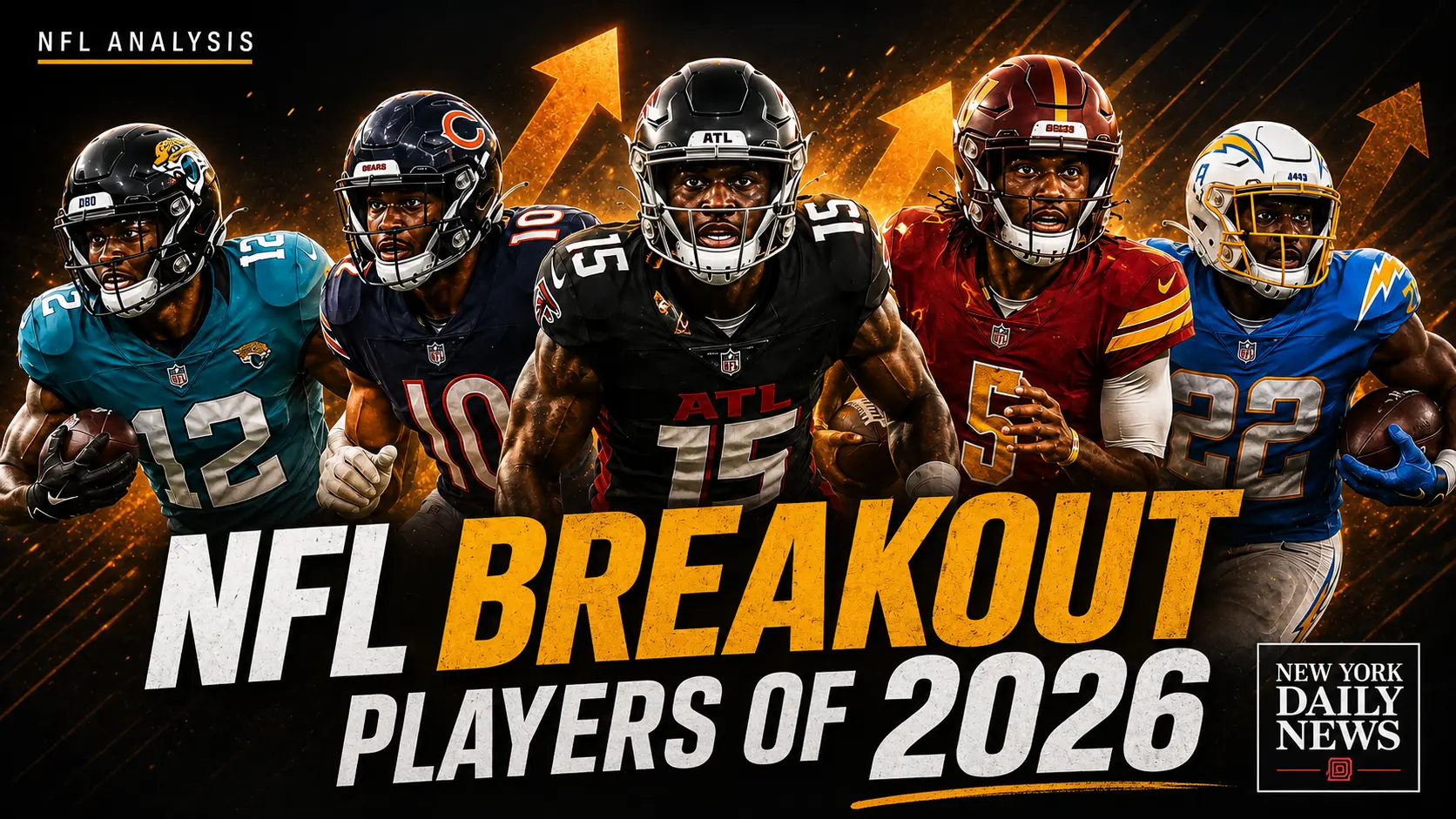
2026 NFL Preview · Breakout Watch
The Best Pass Rusher in Football Had 4 Sacks Last Year. Here’s What That Actually Means.
We sorted eleven breakout candidates into three tiers of confidence: the locks, the believers, and the show-me cases. Find your guy. Then argue with where we put him.
Start with the number that made us write this.
Abdul Carter, third overall pick in the 2025 draft, spent his rookie season doing the hardest thing a pass rusher can do: beating NFL tackles quickly. Next Gen Stats credited him with 72 quarterback pressures, 48 of which arrived in under 2.5 seconds. That quick-pressure figure led the entire league. Not among rookies. Among everyone.
Four sacks. That gap between process and result is the single most interesting thing in football right now, because pressure is the skill that repeats and sacks are the outcome that doesn’t. When the two separate that far, they tend to snap back together.
That’s the logic behind everything below. As former NFL scout Bucky Brooks explains it, evaluators zero in on second- and third-year players who finished the prior season playing well down the stretch. Guys who held their fundamentals, added a wrinkle, then climbed fast. Camps open this week.
So we didn’t rank these eleven players 1 through 11. Ranking implies precision we don’t have. Instead we sorted them into three tiers of confidence, based on how sure we actually are. Some of these are near-certainties. Some are gambles we find interesting. You’ll disagree with at least two of them, and that’s the point.
Jump straight to the player you came here for, then see whether we agree with you.
The ones we’d bet on
Elite talent, a clear runway to snaps, and something concrete in the tape or the numbers pointing up. If these don’t break out, something went wrong.
Hunter’s rookie season ended after seven games because of a knee injury. Seven. The most hyped two-way player to enter the league in decades got roughly a third of a season, most of it at receiver, and then it was over.
2026 changes the premise entirely. He’s expected to move to full-time cornerback with only occasional offensive snaps, and he’s believed to have All-Pro-level ability there. That’s the unlock: the two-way experiment split his reps and slowed his development at both spots. A full season of focus at one elite position is a different player.
Every other name here projects forward from something we’ve watched. With Hunter we’ve barely watched anything. Seven games, two positions, ended early. The distance between what he’s shown and what he can do is the widest gap in football. Jaguars fans who’ve been waiting two years to see it can find the hand-drawn Travis Hunter collection here.
See the tape breakdown
- Why full-time corner matters: Two-way players never get the rep volume to master either role. Coverage is the most technique-dependent position on defense, and it rewards repetition more than raw ability.
- The injury context: A knee injury ending a rookie year is far less alarming than a recurring soft-tissue pattern. One acute injury, one recovery.
- What to watch in camp: How often Jacksonville leaves him on an island. Trust in press-man coverage is the signal that the staff believes the All-Pro projection.
The player from the headline, and the case is mostly arithmetic. League-best quick pressures, four sacks. That gap closes far more often than it persists.
The rookie year had a second storyline, though, and it’s worth being honest about: Carter was benched twice for off-field issues. Once for the opening series after sleeping through a walkthrough before a Week 11 loss to Green Bay, then for an entire first quarter in Week 13 after missing a team meeting. The Giants have been candid about those growing pains.
But look at how it ended: 3.5 of his 4 sacks came in the final five games. The conversion was already starting. Now he joins a front seven new coordinator Dennard Wilson is building around “organized chaos,” lining Carter up with Brian Burns, Kayvon Thibodeaux, rookie Arvell Reese, and Tremaine Edmunds. That’s too many rare athletes to account for at once, and Giants fans betting on the double-digit season can check the full Abdul Carter collection.
See the tape breakdown
- Why pressure predicts sacks: Sack totals swing on things a rusher doesn’t control: how fast the ball comes out, whether a teammate gets there first, whether the QB steps up. Pressure rate is the stable, repeatable measure of the skill itself.
- Under 2.5 seconds is the threshold: That’s roughly the window before a quarterback’s first read is gone. Leading the league there means he was consistently winning before the play developed.
- The real risk: Not talent. Availability and focus. Two benchings in one season is a pattern worth watching, not dismissing.
Scouts obsess over this specific gap for a reason. Rookies spend year one learning a playbook, an NFL body clock, and opponents who are simply better than anything college offered. The ones who finish that season playing well in December, not merely surviving it, are the ones who tend to jump. So watch the back half of a rookie year, not the front. That’s where next season’s stars announce themselves quietly.
Strong evidence, one variable
The film and the situation both say yes. Each of these depends on one thing outside the player’s control: a quarterback, a scheme, a depth chart.
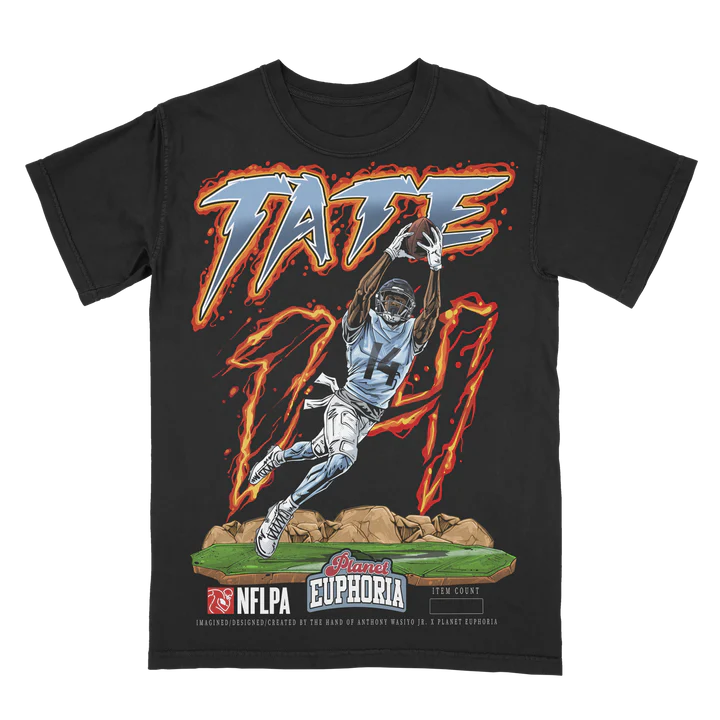
The most consequential name here, because quarterback leaps move entire franchises. Ward enters Year 2 with the thing he conspicuously lacked as a rookie: a real No. 1 target, after Tennessee used the fourth overall pick on Ohio State’s Carnell Tate.
Spring reports were loud about their chemistry, and Ward reportedly leaned on Tate repeatedly through OTAs. Add Gunnar Helm developing at tight end and the Titans have assembled a supporting cast that simply didn’t exist last year. If Ward jumps, the roster’s whole timeline accelerates, and Tennessee fans can rep the leap with a hand-drawn Cam Ward design.
See the tape breakdown
The variable is protection. Weapons only matter if there’s time to find them, and young quarterbacks under pressure regress to panic. Watch the offensive line in preseason. That’s the swing factor between a leap and a plateau.
The only true rookie in the top two tiers, and he’s here because the setup is nearly ideal. Tennessee took him fourth overall specifically to solve Ward’s target problem, and the pairing reportedly clicked from the first spring practice.
“He’s polished” was the word out of camp, an unusual compliment for a rookie receiver and the most predictive one. Polish is the difference between producing in September and figuring it out in December. When a young quarterback and a polished rookie arrive together, the breakouts tend to be mutual, and fans who want to call it early can find the hand-drawn Carnell Tate collection worth a look.
See the tape breakdown
Rookie receivers historically produce least in September and most in December, because the route detail and timing take a season to sync. Tate’s “polish” reputation is a bet that his curve is shorter than usual. The variable is simply whether Ward gets him the ball.
Jeanty enters his second season as one of the offensive names most expected to rise, and his situation just got genuinely interesting: Las Vegas is managing a quarterback transition, with Kirk Cousins holding the job and No. 1 overall pick Fernando Mendoza waiting behind him.
Offenses in flux lean on their running backs. Whoever’s under center, Jeanty is the stabilizer this offense runs through, and volume plus talent is exactly how a good rookie year becomes league-wide recognition. For the fans who were there before the NFL caught on, the Boise State throwback design is the deeper cut.
See the tape breakdown
The variable cuts both ways. A quarterback transition means more carries, but it can also mean stacked boxes if defenses stop respecting the pass. Watch whether Las Vegas commits to him on early downs or leans pass-first with Cousins.
A 2025 first-rounder on the defensive breakout board, and Philadelphia’s timing makes it matter more. The Eagles are navigating real change on offense this season, which pushes weight onto a defense that needs its young pieces to grow up quickly.
Off-ball linebackers live and die on processing speed, and processing is precisely what improves most between Year 1 and Year 2. A linebacker who spent last season thinking becomes a linebacker who spends this one reacting. That’s the entire difference at the position.
See the tape breakdown
The athleticism was never the question. It’s why he went in the first round. The variable is scheme fit and how much green-dot responsibility Philadelphia trusts him with. Watch who wears the communication helmet in August.
Green Bay’s first receiver drafted in the first round since Javon Walker in 2002. Then, as a rookie, a non-factor: 29 catches, 361 yards, zero touchdowns in 14 games. Rough opening chapter for a player who ran sub-4.3 at the combine.
Why chapter two looks different: the departures of Romeo Doubs and Dontayvion Wicks cleared the room. Golden should sit no lower than third on the depth chart, and speed that real doesn’t evaporate in a season. Classic buy-low breakout. The talent never left, the targets simply weren’t there.
See the tape breakdown
Zero touchdowns on 29 catches is the number that scares people off, but it’s also a small sample in a crowded room. The variable is whether the offense actually redistributes those vacated targets to him rather than to the tight ends.
Real cases, real doubts
We like the arrow on all four. We’re just not ready to plant a flag. These are the names that make this list interesting a year from now.
The other half of the Giants’ breakout duo, and a textbook late-season riser. Alexander managed a half-sack across his first 10 NFL games. Then the light came on. Over his final six, the 6-foot-4, 310-pounder posted three sacks and three games with 3+ total tackles.
The pressure numbers agree: eight pressures in that closing stretch, more than his entire first 10 games combined. Interior linemen almost always arrive later than edge rushers. Alexander looks like he arrived in December.
See the tape breakdown
Six games is a small sample, and interior pressure is the most volatile stat on the defensive line. The optimistic read: he benefits enormously from Carter and Burns occupying attention outside. The skeptical read: he benefits because of them, and the production isn’t his.
Tight end is the position where Year 2 leaps are nearly a rule. The learning curve is brutal, and then abruptly it isn’t. Helm lands here as part of a Titans group quietly assembling weapons around Cam Ward.
Opportunity is the whole argument. Tennessee needs middle-of-field reliability, and young quarterbacks lean on tight ends more than any other target. If Ward takes his step, Helm is the likeliest beneficiary nobody’s talking about yet.
See the tape breakdown
The doubt: Tate just arrived as the clear No. 1, and there are only so many targets. Helm’s ceiling may be capped by the same addition that raises Ward’s. Watch red-zone usage specifically. That’s where tight ends carve out real value.
Nickel corner is the most thankless job in football and one of the most valuable. Stout played primarily in the slot as a rookie, flashed genuine upside, and has been flagged as a potential difference-maker on a defense that historically maximizes this exact archetype.
Slot corners who jump in Year 2 rarely show up in highlight packages, but they change what an offense is permitted to do. Watch how often San Francisco trusts him on third down in August. That’s the leading indicator.
See the tape breakdown
“Flashed upside” is the most dangerous phrase in scouting, because it describes both future starters and career backups. The honest read is that we need a bigger sample. The 49ers’ track record with defensive backs is doing a lot of the work in this projection.
Not a household name, which is precisely the point. Offensive line breakouts are invisible until suddenly they aren’t. Morgan, a 2024 first-rounder, has been in and out of the lineup since his rookie season and is projected to play left tackle full-time in 2026 alongside 2025 second-rounder Anthony Belton.
Green Bay’s line took a visible step back last season, and the whole offense moves with that unit. If Morgan finally holds one job for 17 games, every skill player around him looks better, and nobody will credit the guy who made it happen. Consider this his credit.
See the tape breakdown
The doubt is durability and consistency, not ability. Two seasons of bouncing in and out of a lineup is itself information. The bull case is simple: he’s never had a clean, uninterrupted run at one position. The bear case is that there’s a reason for that.
Where We’d Put Our Money
Carter’s pressure-to-sack gap is the most predictive number on this page. That kind of separation between process and outcome almost always corrects. But Hunter is the one who could change how an entire defense is constructed, simply by being available and being asked to do one thing well.
The pattern worth carrying into the season: watch how young players finish, not how they start. Alexander’s last six games. Carter’s last five. Ward’s second half. December tape is next September’s breakout list, and camps open this week.
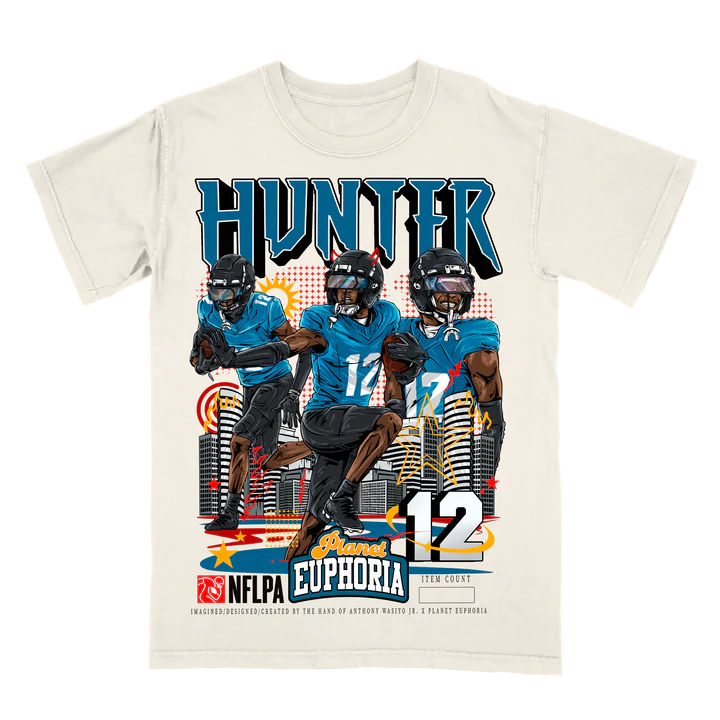 Travis Hunter
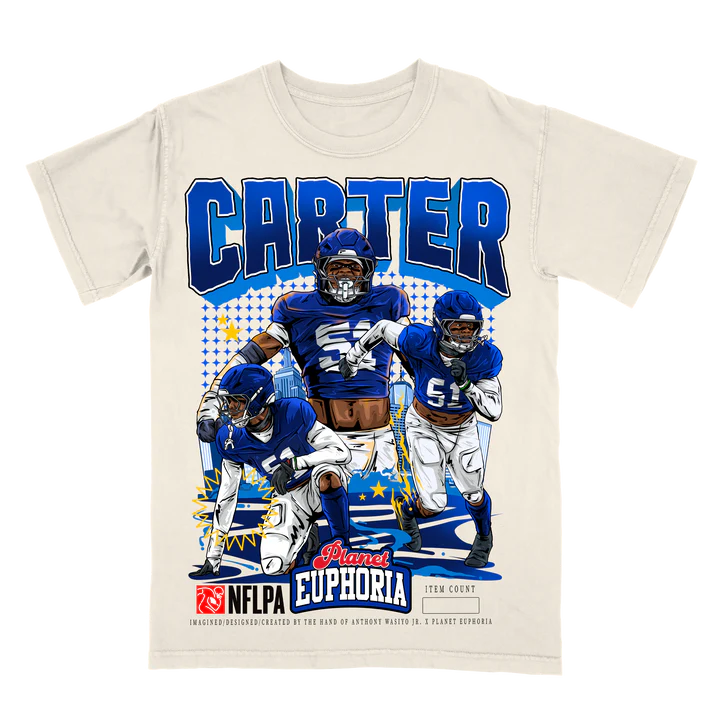 Abdul Carter
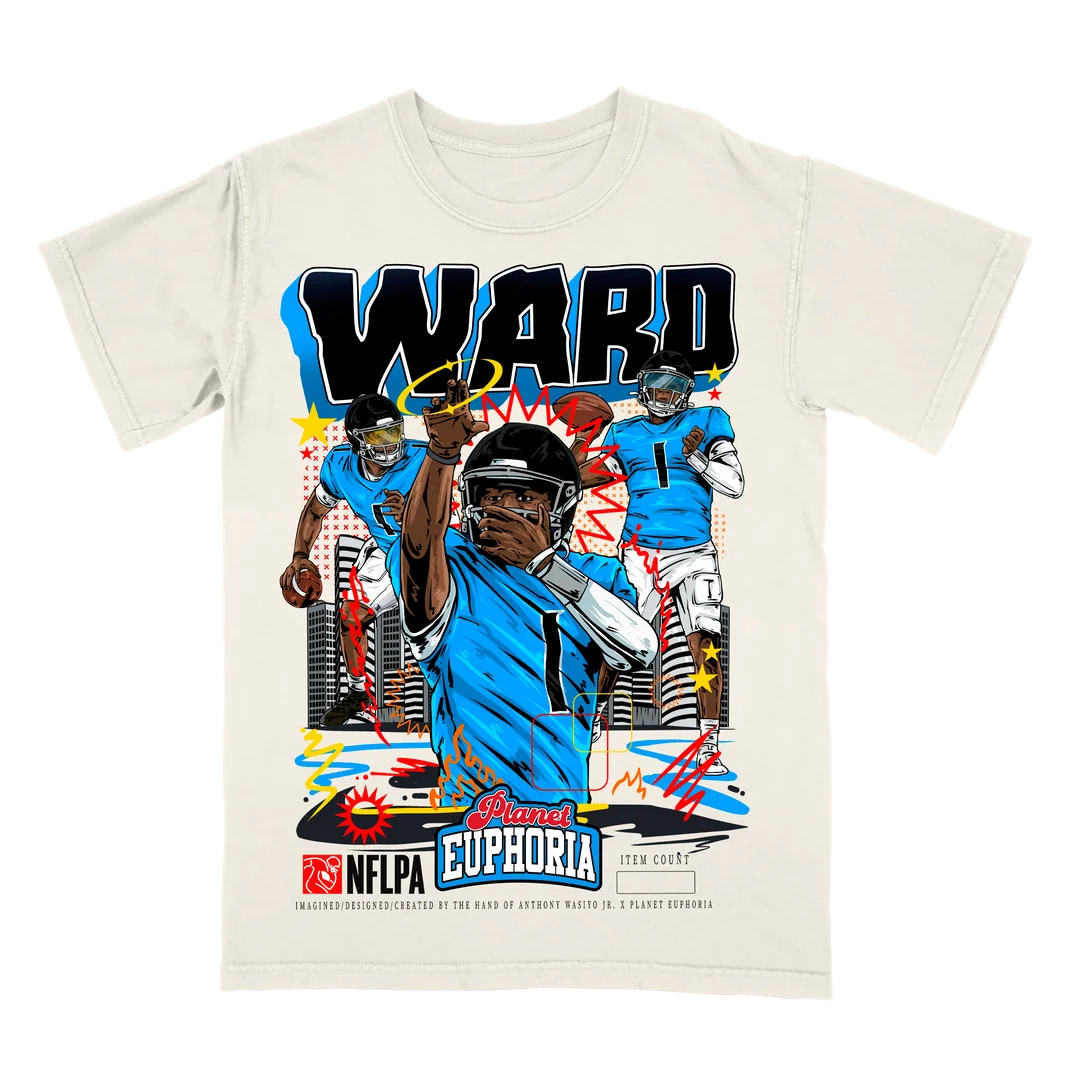 Cam Ward
 Ashton Jeanty
 Carnell Tate
2026 NFL Breakout Players: Your Questions, Answered
Why is Abdul Carter expected to break out in 2026?
Why did Travis Hunter’s rookie season end early?
What makes a player a “breakout” candidate?
Which 2026 breakout candidate could have the biggest team impact?
Player situations, statistics, and scouting assessments verified via NFL.com, New York Giants official reporting, Next Gen Stats, and Pro Football Focus as of July 2026. Confidence percentages are the author’s editorial judgment, not a statistical model. Roles and projections reflect offseason reporting and are subject to change through training camp.
For a closer look at the incoming class behind these breakouts, see our rundown of the 2025 NFL rookie class.
Related articles: How NYC Parks Permits Actually Work for Rec League Sports Teams · Caleb “Iceman” Williams and His Smooth Post-Rookie Recovery · Jaxson Dart Has Drip