
Roughly one in seventeen New Yorkers lives in public housing, and most of them learn the repair-request system by trial and error rather than being told how it actually works. NYCHA’s process has real rules and real timelines behind it, even when the wait feels endless. Here’s what actually governs a repair request, and what to do when the standard channel stalls.
NYCHA is the landlord, and habitability rules still apply
The New York City Housing Authority is the public agency that owns and operates the largest public housing system in North America, and legally it functions as the landlord for every unit it manages. That means the same basic habitability obligations that apply to private landlords – working heat, hot water, no active leaks, functioning locks – apply to NYCHA too. The size of the agency doesn’t change the underlying legal standard, even though enforcement against a public landlord looks different in practice than a private one.
Every repair request gets a priority classification, whether you’re told or not
When a repair ticket is filed, NYCHA internally classifies it by urgency – emergency conditions like no heat in winter or a gas leak get same-day or next-day targets, while cosmetic or non-urgent repairs get a longer window measured in weeks. The system doesn’t always communicate this classification back to the tenant clearly, which is why two requests filed the same week can have wildly different response times without any explanation given. Asking the call center directly what priority level your ticket received is a reasonable question, and one most tenants never think to ask.
A ticket number is your paper trail – write it down every time
Every repair request generates a work order number, whether filed by phone, through the MyNYCHA app, or in person at the management office. That number is the single most useful thing you can hold onto if a repair stalls, because it lets you reference a specific request rather than restating the problem from scratch on a follow-up call. Tenants who track their own work order numbers consistently get faster resolution on repeat contacts than those who call in as if it’s the first time every time.
Heat and hot water complaints have a faster track for a reason
New York City’s heat season runs from October through May, and buildings are legally required to maintain minimum indoor temperatures during that window regardless of who owns the building. Because this is a citywide code requirement, not just a NYCHA internal policy, heat and hot water complaints can also be filed directly with the city’s 311 system, which creates a separate, independently tracked record outside NYCHA’s own ticketing system. Filing in both places isn’t redundant – it’s two paper trails instead of one, which matters if a dispute drags on.
Mold and pest complaints often need a specific request, not a general one
A general “there’s a problem in my apartment” ticket doesn’t always route to the right specialized team. Mold remediation and pest control frequently have dedicated request categories separate from standard maintenance, and naming the specific issue explicitly when filing – not just describing symptoms – helps the ticket land with the crew equipped to handle it the first time, rather than bouncing between departments.
Resident association leadership can escalate faster than an individual tenant
Every NYCHA development has a resident association, and building-wide or development-wide issues – not just single-apartment repairs – often move faster when raised through that body rather than as an individual complaint. Resident association leaders typically have direct contact with property management and can flag patterns (multiple apartments reporting the same issue, for instance) in a way that carries more institutional weight than one tenant’s repeated calls.
Capital repair timelines run on a separate, much longer track than individual work orders
Large-scale capital repairs — roof replacement, elevator modernization, heating system overhauls — follow a separate NYCHA capital planning and funding process that can take years, distinct from the individual work-order system covering unit-level repairs. Residents sometimes conflate a slow-moving capital repair project with an unresolved individual work order, when the two actually run on entirely different tracks with different realistic timelines.
HUD and the city both have independent oversight roles
NYCHA operates under both federal oversight from the U.S. Department of Housing and Urban Development and a separate city-level monitor established through prior litigation over unresolved repair backlogs. Complaints that go unresolved through NYCHA’s own channels for an extended period can be escalated to these outside oversight bodies, which exist specifically because internal resolution doesn’t always work as designed. This isn’t a step to jump to immediately, but it’s a real option that most tenants don’t know exists.
Next step: if you have an open repair request that’s been sitting for more than two weeks past what you were told to expect, call back and ask specifically for the work order’s current status and priority classification – having the ticket number ready turns a vague follow-up into a concrete one.
New York Daily News accepts guest contributions on NYC real estate and housing topics — see our Real Estate write-for-us page if this is your beat.
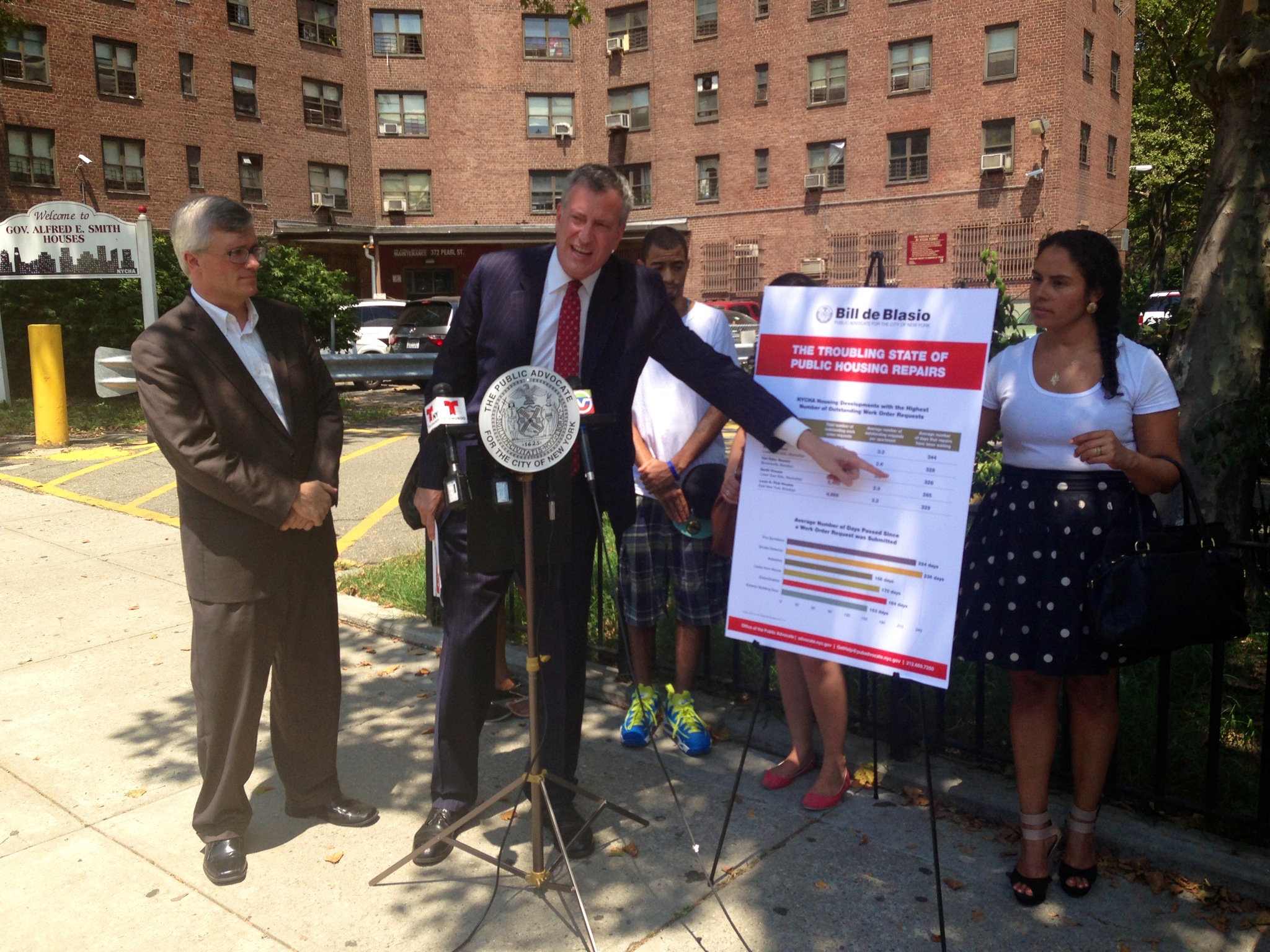
Photo: “De Blasio Demands Prioritization of Most Critical NYCHA Repairs” by Bill de Blasio, licensed under CC BY-SA 2.0 (https://creativecommons.org/licenses/by-sa/2.0/).