

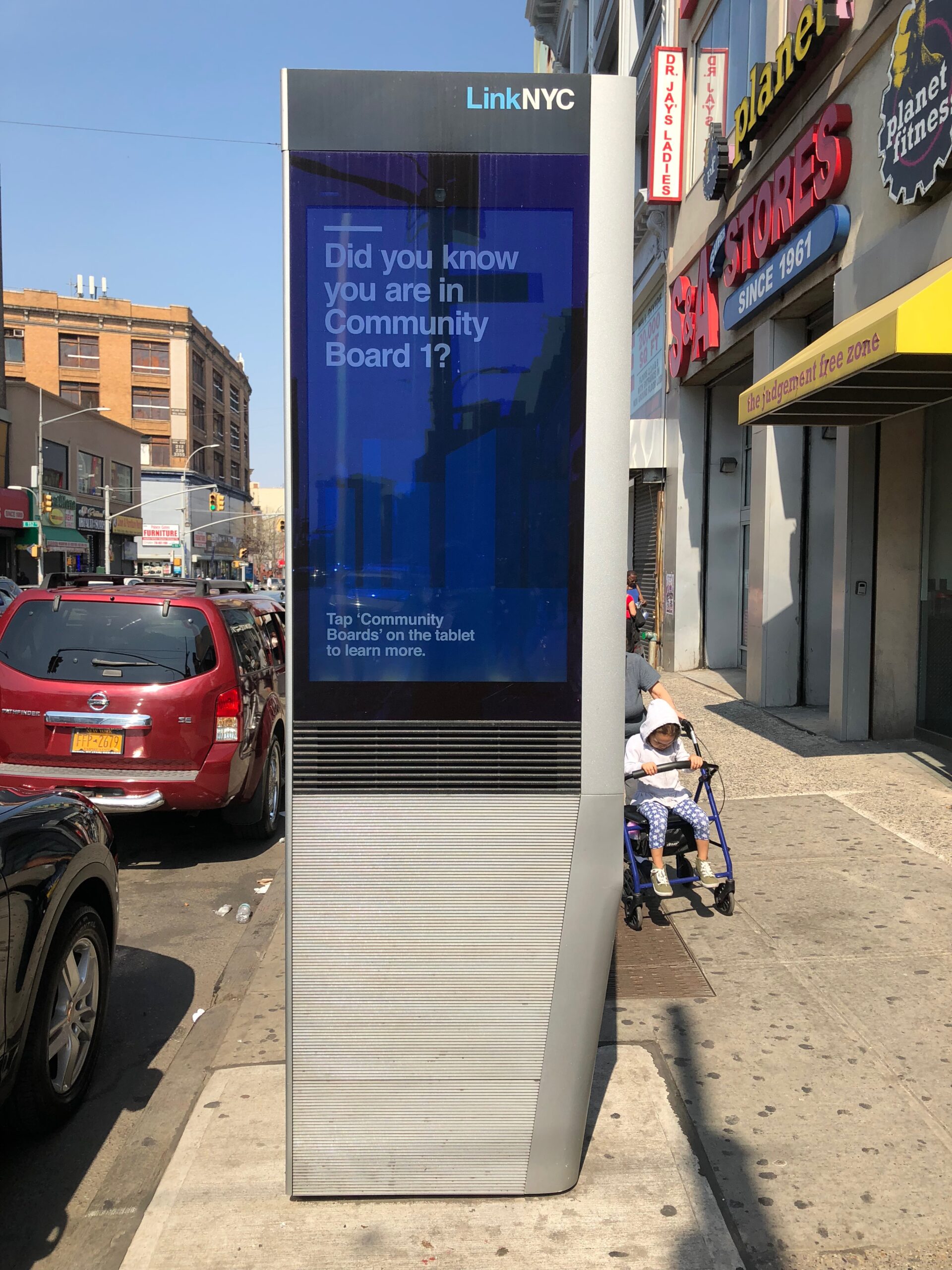
Over 1,900 LinkNYC kiosks stand on street corners across the five boroughs, and most New Yorkers know them only as the tall black structures they walk past without a second look. The program replaced the city’s old payphone network with free Wi-Fi, phone calls, and device charging — funded entirely through advertising, not tax dollars. Here’s what the kiosks actually do and where the program has run into real limits.
The Wi-Fi is genuinely free and doesn’t require an account
Any device within roughly 150 feet of a kiosk can connect to the LinkNYC Wi-Fi network without creating an account, entering payment information, or watching an ad — a deliberate design choice meant to keep the barrier to entry at zero, unlike many “free” public Wi-Fi networks that gate access behind a sign-up form. The connection is genuinely free public infrastructure, not a lead-generation tool, which distinguishes it from most retail and transit Wi-Fi offerings.
Free phone calls anywhere in the US are still part of the service, though less used now
Each kiosk includes a built-in tablet with a keypad for making free phone calls to any US number, a holdover feature from the payphone-replacement origins of the program that gets far less use now that most passersby carry their own phones. The feature remains functional and matters most for people without a working phone of their own, a population the original payphone network served for decades before LinkNYC replaced it.
USB charging ports exist but reliability varies by kiosk
Most LinkNYC kiosks include USB charging ports built into the base, intended for quick phone charging while standing at the kiosk — but port functionality varies across the network, with older or damaged units sometimes having non-working charging ports that aren’t always flagged for repair quickly. Testing the port before relying on it for anything beyond a few minutes of charge is a reasonable precaution, especially at kiosks that look weathered or heavily used.
The advertising-funded model means kiosk density follows ad revenue potential, not just need
LinkNYC kiosks are funded through the digital advertising displayed on their sides, which means kiosk placement decisions have historically favored higher-foot-traffic commercial corridors over lower-income residential areas where advertising revenue is lower — a real equity criticism that’s been raised repeatedly since the program’s launch. The city and the program’s operator have made adjustments to address this, but the underlying funding model still ties infrastructure density partly to commercial ad value rather than purely to neighborhood need.
Camera and sensor capabilities exist and have drawn genuine privacy scrutiny
Many LinkNYC kiosks include environmental sensors and cameras, originally intended for city planning data and public safety use — a capability that privacy advocates have flagged as worth ongoing scrutiny, since a citywide network of internet-connected, sensor-equipped public infrastructure is a meaningfully different privacy proposition than a standalone free Wi-Fi hotspot. The program has published data-use policies addressing this, but it’s a legitimate point of continued public debate, not a settled non-issue.
The tablet screens were pulled from public browsing after early misuse problems
LinkNYC originally included open web-browsing tablets built into each kiosk, a feature the city suspended in 2016 after widespread reports of the tablets being used to watch pornography and other content in public, loiter for extended periods, and in some cases facilitate illegal activity at the kiosk itself. The tablets now serve a much more limited function (maps, city services information, emergency calling) rather than open internet access — a case where an ambitious original feature was scaled back after real-world problems, not from a lack of technical capability.
Kiosk locations aren’t evenly distributed across all five boroughs
Manhattan has the densest concentration of LinkNYC kiosks by a wide margin, followed by Brooklyn and the Bronx, with Staten Island having by far the fewest installations of any borough — a gap that roughly tracks each borough’s street-level commercial density and population, though Staten Island residents and advocates have specifically pushed for more equitable rollout. Checking the current kiosk map for a specific neighborhood before counting on free Wi-Fi being available nearby is worth doing, since coverage isn’t uniform citywide the way subway or bus coverage roughly is.
The program has survived multiple ownership and operator changes
LinkNYC has gone through changes in its operating consortium since its 2016 launch, including changes tied to the program’s original advertising partner, without interrupting basic kiosk service for users — worth knowing if you’ve heard conflicting information about whether the program is still active. As of now, the network remains operational and free to use across its existing kiosk footprint.
The city collects real revenue from the program, beyond just providing free service
LinkNYC’s advertising-funded structure was also designed to generate franchise revenue for the city itself, not just cover the program’s own operating costs — a detail that positions LinkNYC as a genuine public-private infrastructure deal rather than a pure city expenditure. This funding structure is part of why the program has proven durable across ownership changes: it’s not dependent on annual city budget allocation the way many public technology programs are.
The network has expanded well beyond its original Manhattan-heavy footprint
LinkNYC’s initial rollout concentrated in Manhattan’s densest commercial corridors, but the network has continued expanding into residential neighborhoods across all five boroughs in the years since — meaning a neighborhood without kiosk coverage a few years ago may well have it now. Checking the current kiosk map rather than relying on an old memory of “there’s no LinkNYC near me” is worth doing periodically, since the network’s footprint has genuinely changed over time rather than staying static since 2016.
Next step: if you’re near a LinkNYC kiosk and need Wi-Fi, a charge, or a free call, it’s genuinely free to use right now — no app, account, or sign-up required, just connect and go.
New York Daily News accepts guest contributions on NYC technology topics — see our Technology write-for-us page if this is your beat.
Photo: “LinkNYC kiosk 3rd Ave Bronx” by Hugo L. González, licensed under CC BY-SA 4.0 (https://creativecommons.org/licenses/by-sa/4.0/).