

Every storefront inside one of New York City’s 76 Business Improvement Districts pays an extra assessment on top of property taxes, and most owners can’t say exactly what they get for it. The answer, more often than not, is shared marketing they never asked for by name but are already funding. Here’s how BID-funded marketing actually works, and how to get more out of it.
A BID is a legal taxing structure, not a chamber of commerce
A Business Improvement District is a defined geographic area where property owners vote to assess themselves an additional fee, collected alongside property taxes, to fund services beyond what the city already provides — sanitation, security, streetscape improvements, and marketing among them. This is a legal structure with real enforcement behind it, not a voluntary membership group a business can simply decline to join once the district is established and the assessment is in place.
Marketing budgets vary enormously between districts
A large, well-established BID like the Times Square Alliance or the Grand Central Partnership operates with a multi-million dollar annual budget and a dedicated marketing staff, while a smaller neighborhood BID might have a marketing line item in the tens of thousands of dollars run by one part-time coordinator. A business owner assuming their BID has the same marketing capacity as a famous one two neighborhoods over is usually wrong, and that assumption is exactly why so many owners never bother asking what’s actually available.
Shared social media accounts are the most underused benefit
Most BIDs run an Instagram or Facebook account promoting the district as a shopping and dining destination, and individual businesses can usually request to be featured — a new menu item, a seasonal sale, a renovation — at no additional cost beyond what they’re already paying into the assessment. The catch is that most BIDs don’t proactively solicit this content; a business has to reach out directly to the BID’s marketing or communications contact and ask, rather than waiting to be noticed.
District-wide events function as free foot-traffic marketing
Street fairs, holiday markets, and seasonal shopping promotions organized by a BID are marketing events in function even when they’re framed as community programming, and participating storefronts typically get included in the associated print and digital promotion at no extra charge. Businesses that decline to participate in these events — often because they assume there’s a hidden fee — lose out on foot traffic and marketing exposure that non-participating storefronts on the same block are getting for free.
Some BIDs offer direct grants or matching funds for storefront improvements
A number of BIDs run facade improvement or storefront grant programs that partially fund signage, awnings, or window displays — all of which function as marketing since a storefront’s physical appearance is itself an advertisement to foot traffic. These programs are usually capped and awarded on a rolling or annual basis, so a business that checks once and finds the fund exhausted should still check back the following budget cycle rather than assuming the program no longer exists.
BID board meetings are open, and marketing budgets are discussed there
BID board meetings are generally open to member businesses and often to the public, and marketing spend is a standing agenda item at most annual and quarterly meetings. A business owner who wants a specific type of support — a dedicated social media post, inclusion in a print map, a request to fund a particular event — has real standing to raise it at one of these meetings rather than assuming decisions happen entirely behind closed doors.
Not every commercial block is inside a BID
BID boundaries are specific and don’t cover every commercial corridor in the city — a business two blocks outside a BID’s boundary gets none of its marketing benefits despite being in a similar retail environment. Checking whether a specific address falls inside an existing BID’s mapped boundary, rather than assuming based on neighborhood name alone, is the first real step before expecting any of these programs to apply.
The assessment is calculated by property value, not evenly split
A BID’s total budget is divided among member properties based on a formula tied to assessed property value, frontage, or square footage — not an equal flat fee per business — so a small tenant in a large building and the anchor tenant next door can be paying very different amounts into the same marketing fund. Two businesses on the same block sometimes assume they’re contributing equally and therefore should get equal marketing attention, when the actual assessment split can be lopsided enough to justify one business reasonably expecting more visibility than the other.
Non-payment carries the same consequences as unpaid property tax
Because the BID assessment is collected as a supplemental charge on the property tax bill, failing to pay it triggers the same lien and enforcement process as unpaid property taxes, not a simple opt-out. This surprises some business owners who treat the assessment as if it were a voluntary membership dues payment they can quietly stop making if they feel the marketing return isn’t worth it — it isn’t voluntary once the district is legally established, regardless of how the marketing benefit is used or ignored.
The city maintains a public list of every BID and its district manager
NYC’s Department of Small Business Services maintains a public directory of all active Business Improvement Districts, including boundary maps and contact information for each district manager — the person actually responsible for that BID’s marketing programs. This is a five-minute lookup that most business owners paying a BID assessment have simply never done, despite it being the single fastest way to find out exactly what they’re entitled to.
For the broader digital side of this, see our breakdown of how local SEO actually works for NYC businesses.
Next step: if you own or manage a storefront in NYC, look up your address in the city’s BID directory this week and email your district manager directly asking what marketing programs are currently available — if you’re already paying the assessment, there’s no reason to leave that benefit unclaimed.
New York Daily News accepts guest contributions on NYC small business and marketing topics — see our Marketing write-for-us page if this is your beat. Also see our related piece on free NYC marketing help most small business owners never use.
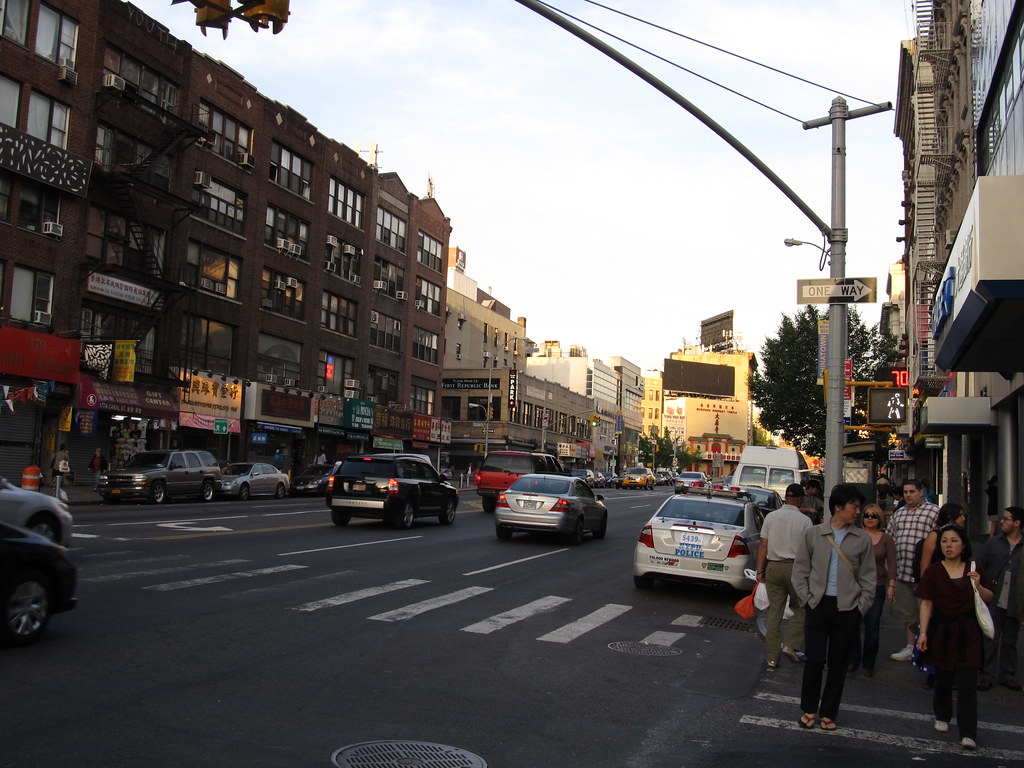
Photo: “Canal Street, Chinatown, Manhattan, New York” by Ken Lund, licensed under CC BY-SA 2.0 (https://creativecommons.org/licenses/by-sa/2.0/).