

Of the roughly 104,500 active for-hire vehicles licensed to operate in New York City right now, more than three out of every four are registered to a single company. Based on the city’s own live TLC vehicle registry, here’s what the actual numbers show about who’s actually driving NYC’s for-hire fleet.
The citywide total: just over 104,500 active licensed vehicles
NYC’s Taxi and Limousine Commission currently lists 104,567 active for-hire vehicle licenses citywide, based on the TLC’s own public vehicle registry, which is updated on a rolling basis as vehicles are added, renewed, or deactivated. This figure covers for-hire vehicles specifically — the licensing category we’ve covered in more depth in our breakdown of what TLC licensing actually requires — and does not include the separate, smaller category of medallion yellow taxis, which are licensed and tracked under a different TLC system entirely.
A single company accounts for more than three-quarters of the active fleet
Uber USA, LLC is listed as the base affiliation for 80,730 of the city’s active for-hire vehicles — 77.2% of the entire citywide total. No other base company comes remotely close: the next largest, Tri-City LLC, accounts for just 1,175 vehicles, barely more than 1% of Uber’s total. This concentration means that when people talk about “NYC’s for-hire vehicle industry” in aggregate, they are, numerically speaking, talking overwhelmingly about a single company’s affiliated fleet.
Lyft doesn’t appear as its own base in this dataset, and that’s a real quirk worth understanding
Unlike Uber, which registers its own dedicated TLC base entity, Lyft vehicles in NYC operate under a range of third-party base affiliations rather than a single “Lyft”-named base in the TLC’s public registry — meaning Lyft’s actual citywide vehicle count is real but distributed across many smaller, separately-named bases rather than consolidated under one easily countable line item the way Uber’s is. This is a structural feature of how Lyft’s NYC operations are set up, not evidence that Lyft has few drivers; it does mean any single-base fleet count understates Lyft’s true footprint relative to how cleanly Uber’s shows up.
Wheelchair-accessible vehicles remain a small fraction of the active fleet
Of the 104,567 active vehicles, 8,897 (8.5%) are designated as wheelchair-accessible (WAV), with an additional 416 vehicles under a separate “pilot” accessibility designation — meaning roughly 91% of NYC’s for-hire fleet is not equipped for wheelchair users at all. This gap has been a real, ongoing point of advocacy and regulatory pressure, since it means riders who require a wheelchair-accessible vehicle are drawing from a meaningfully smaller pool of available cars than riders who don’t.
The remaining base companies are, numerically, a long tail
After Uber and the handful of mid-sized bases (each in the 700-1,200 vehicle range), the rest of the city’s roughly several hundred licensed base companies each operate comparatively small fleets — a genuine long-tail distribution rather than a handful of comparably-sized major players competing for market share. This has real implications for anyone reporting on or regulating the industry: policy built around “the big players” numerically means policy built around one company’s fleet, not a competitive field of several.
This registry reflects licensed vehicles, not active daily drivers
An active TLC vehicle license means a vehicle is currently authorized to operate as a for-hire vehicle — it does not mean that specific car is on the road picking up rides every day, or even regularly. Some licensed vehicles sit inactive for real stretches (between drivers, undergoing maintenance, or held by a base as spare fleet capacity), so the 104,567 figure represents licensing capacity, not a live daily headcount of vehicles actually working the streets on any given day.
More than a quarter of the active fleet is already hybrid or fully electric
Of the 104,567 active vehicles, 15,318 are registered as hybrid and 13,573 as battery-electric, meaning roughly 27.6% of the entire for-hire fleet is already electrified in some form — a real, measurable shift that outpaces electrification rates in NYC’s personal vehicle population — see our earlier piece on the city’s EV charging infrastructure for the supporting-infrastructure side of this trend. The remaining majority, just under 64%, are registered as standard gas vehicles, with diesel and other fuel types making up a negligible remainder.
The active fleet skews toward newer vehicles, consistent with TLC’s age rules
Vehicle-year data shows the active fleet concentrated in recent model years — 2023 alone accounts for 20,450 vehicles, with 2024 and 2025 each contributing over 11,000 more — a distribution consistent with TLC’s vehicle age limits, which push older cars out of eligibility over time regardless of condition. This means the citywide for-hire fleet, taken as a whole, skews meaningfully newer than the city’s general personal vehicle population, where no equivalent age-limit rule applies.
Fleet concentration has real implications for driver bargaining power
When a single company’s affiliated fleet accounts for more than three-quarters of the citywide total, that company’s own policies — pay rates, deactivation practices, fare structures — function close to industry-wide standards by default, simply due to scale, rather than one competitive option among several roughly equal players. This concentration is part of why NYC-specific minimum pay standards for app-based drivers, discussed in our TLC licensing piece, carry outsized practical weight: they apply across a fleet where one company’s operating model already sets the de facto baseline for most working drivers.
Next step: if you’re evaluating the NYC for-hire vehicle market for a business decision or news angle, check the TLC’s own registry directly for current figures rather than citing a fixed number — this dataset updates in near real time as vehicles are licensed and deactivated, so today’s exact count will already differ somewhat from what’s reported here.
Data source: NYC Open Data, TLC Active Vehicles dataset, queried August 2026. New York Daily News accepts guest contributions on NYC automotive and transportation topics — see our Automotive write-for-us page if this is your beat.
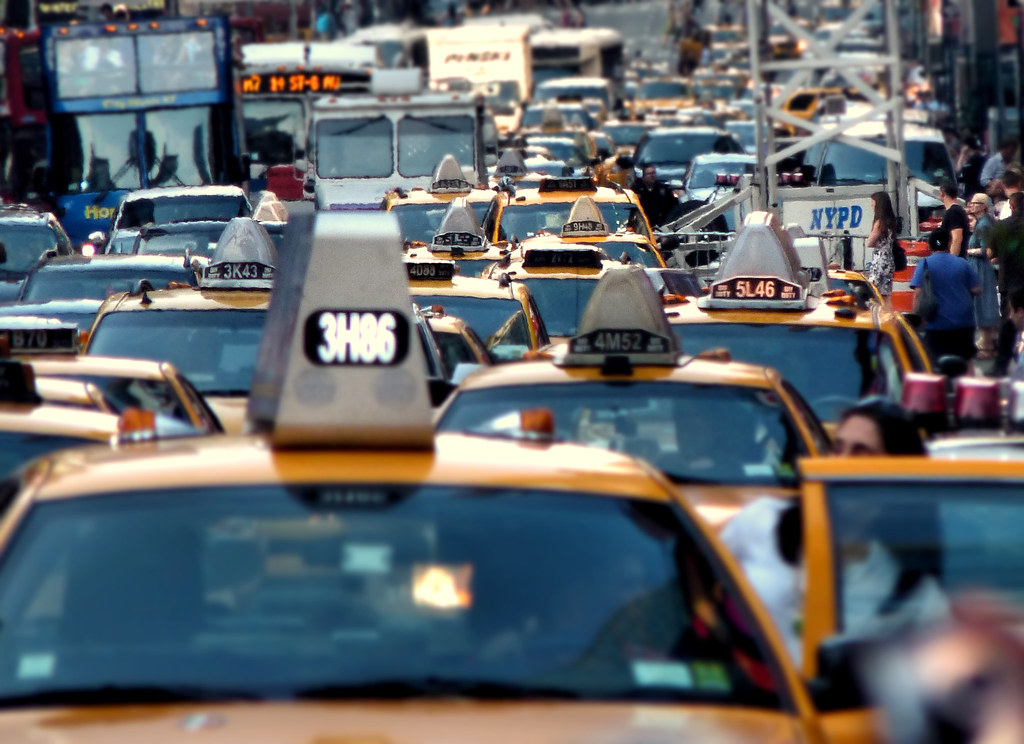
Photo: “World Class Traffic Jam 2” by joiseyshowaa, licensed under CC BY-SA 2.0 (https://creativecommons.org/licenses/by-sa/2.0/).
For another example of how thin the MTAs operational margins really are, see our piece on the OMNY card outage and what it exposed.